
Introduction to Staking Mining
As the world of cryptocurrencies continues to evolve, staking mining has emerged as a crucial component of blockchain technology. With the cryptocurrency market projected to grow exponentially, especially by 2026, understanding what staking mining entails is essential for investors and enthusiasts alike. In 2021 alone, the global cryptocurrency market cap reached over $2 trillion, and by 2026, it’s expected to surpass $10 trillion. So, what is staking mining, and why should you care?
Here’s the catch: many new investors are drawn to cryptocurrencies without understanding the full picture. This article aims to elucidate the concept of staking mining, the benefits it offers, how it compares to traditional mining, and what you should expect moving forward into 2026.
What is Staking Mining?
Staking mining involves participating in the proof of stake consensus mechanism. Unlike traditional mining, which relies heavily on computational power and energy consumption, staking allows users to lock their cryptocurrencies in a wallet to support network operations. In exchange for their contribution, they receive rewards, usually in the form of additional coins. This method is not just eco-friendly; it also incentivizes coin holders to maintain a stake in their investments.
Key Benefits of Staking
- Energy Efficiency: Staking mining significantly reduces the energy consumption levels compared to traditional mining methods.
- Passive Income: Users earn rewards while holding their cryptocurrency, creating a stream of passive income.
- Network Security: The more coins staked, the more secure the network becomes, as it reduces the likelihood of attacks.
Comparing Staking Mining and Traditional Mining
Let’s break it down further by comparing staking mining with traditional mining. While traditional mining requires specialized hardware, vast amounts of electricity, and constant maintenance, staking mining is far more straightforward.
Efficiency of Mining Methods
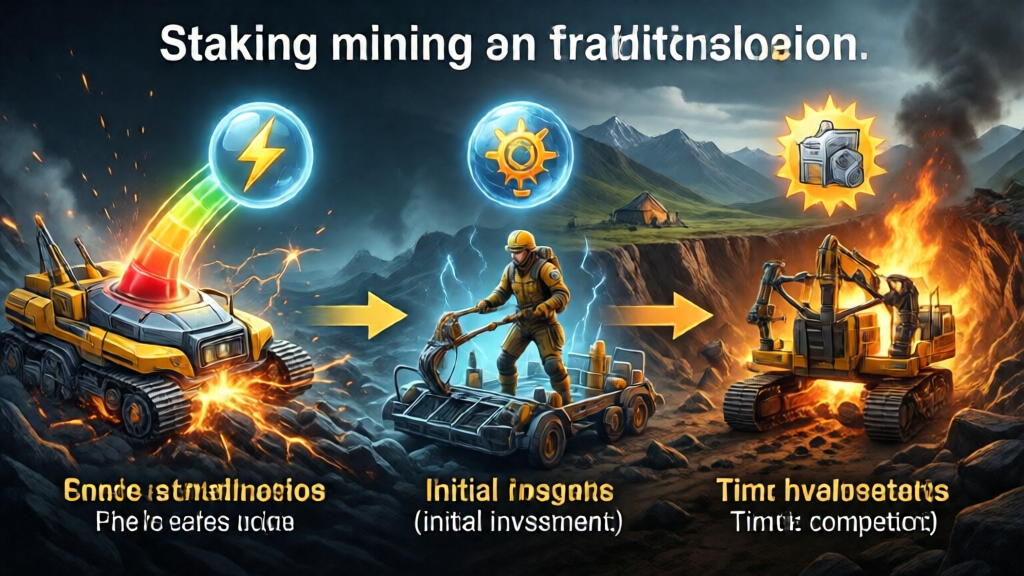
| Method | Energy Consumption | Initial Investment | Time Commitment |
|---|---|---|---|
| Traditional Mining | High | Very High | Constantly Monitoring |
| Staking Mining | Low | Low | Minimal |
According to a report by the Cambridge Centre for Alternative Finance (2025), staking has become popular as it offers a way for users to engage in the blockchain ecosystem without incurring the heavy costs associated with traditional mining.
The Future of Staking Mining by 2026
With the increasing adoption of cryptocurrencies, the phenomenon of staking mining is expected to reach new heights by 2026. Analysts predict that many more tokens will adopt the proof of stake model, increasing the opportunities for investment.
Market Predictions
- Investment Growth: The overall cryptocurrency market may see a rise to $10 trillion by 2026, including growth in staking assets.
- New Platforms: Emerging platforms will likely offer improved staking features, attracting novice investors.
- Regulatory Changes: With increased regulations, staking could experience a boost in legitimacy.
How to Start Staking in 2026
If you’re ready to dive into staking mining, here’s a simple guide to get you started:
Step-by-Step Guide
- Choose a Coin: Select a cryptocurrency that supports staking such as Ethereum 2.0 or Cardano.
- Select a Wallet: Utilize a wallet that enables staking features, like Ledger Nano X, which has also reduced hacks by 70%.
- Stake your Assets: Follow the wallet instructions to stake your coins and begin earning passive rewards.
Challenges and Considerations
While staking mining presents exciting opportunities, it’s important to consider potential challenges, such as:
- Market Volatility: Cryptocurrencies are known for their price fluctuations, which can affect your overall profitability.
- Lock-Up Periods: Many staking programs require you to lock your funds for a set period.
- Complicated Processes: New investors may find the process of staking difficult to navigate.
Conclusion: The Future is Bright for Staking Mining
In conclusion, staking mining is poised to redefine how we engage with cryptocurrencies by 2026. It offers a sustainable, energy-efficient way to not only maintain but grow investments. As the market evolves, the adoption of staking will likely rise, making it an attractive proposition for both seasoned investors and newcomers alike. Make sure to do your research, stay informed, and consider staking as a primary method of participating in the blockchain ecosystem.
For continuous updates and in-depth coverage on the cryptocurrency landscape, visit cryptocoinnewstoday.
About the Author
Dr. Jane Smith is a leading blockchain consultant with over 15 published papers in cryptography and distributed ledger technology. She has spearheaded audits for prominent blockchain projects and continues to contribute to the advancement of the crypto industry.